
Plans for Michael Jackson's funeral are slowly coming together. His father, Joe Jackson, announced that the memorial will be large and open to the public. No doubt the turnout for the ceremony will be extraordinary. If there's one thing Michael Jackson's death has proven, it's that his fans and all those who loved him have not gotten less loyal over the years.
Speaking at a press conference, Joe Jackson revealed that as of yet, there is no date for the funeral as the family is not planning to set a date until they know exactly how Michael died. A first autopsy proved inconclusive, and the family is now awaiting the results of a second one. Said Joe Jackson, "We aren't ready for [releasing information on the funeral.] We don't have the time frame yet because we want to see when the private autopsy comes out."
Addressing Michael Jackson's fans he said, "The family and I are very proud to see all of you come out here and help us with this whole situation because we know that we do have fans all over the world and we know that we're loved all over the world. But one thing that I wish could have happened - I wish that Michael could be here to see all of this. [We] had to wait until something happened like this before it could be realized. Michael was a superstar... he was loved all over the world."
Joe Jackson also addressed the criticism he's received for plugging his record label on Sunday night while being interviewed on the red carpet at the BET awards. In response to some people's criticisms that it was the wrong time and place for such a plug, Jackson said, "Now I was asked that question and I answered just like it was asked because they wanted to know what else I was doing." Because we do believe Joe Jackson is genuinely in mourning, we'll bite our tongues.
Tuesday, June 30, 2009
Michael Jackson's funeral to be open to the public.

Tuesday, June 16, 2009
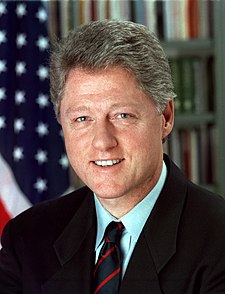
Bill Clinton
I like this guy.He makes love,not war!Probably the best US President in modern history. William Jefferson "Bill" Clinton (born William Jefferson Blythe III, August 19, 1946) served as the 42nd President of the United States from 1993 to 2001. He was the third-youngest president; only Theodore Roosevelt and John F. Kennedy were younger when entering office. He became president at the end of the Cold War, and as he was born in the period after World War II, he is known as the first Baby Boomer president. His wife, Hillary Rodham Clinton, is currently the United States Secretary of State. She was previously a United States Senator from New York, and also candidate for the Democratic presidential nomination in 2008. Both are graduates of Yale Law School. Clinton was described as a New Democrat and was largely known for the Third Way philosophy of governance that came to epitomize his two terms as president. His policies, on issues such as the North American Free Trade Agreement and welfare reform, have been described as centrist. Clinton presided over the longest period of peace-time economic expansion in American history, which included a balanced budget and a reported federal surplus. Based on Congressional accounting rules, at the end of his presidency Clinton reported a surplus of $559 billion. On the heels of a failed attempt at health care reform with a Democratic Congress,Republicans won control of the House of Representatives for the first time in forty years. Two years later, in 1996, Clinton was re-elected and became the first member of the Democratic Party since Franklin D. Roosevelt to win a second term as president. Later he was impeached for obstruction of justice, but was subsequently acquitted by the U.S. Senate. Clinton left office with an approval rating at 66%, the highest end of office rating of any president since World War II. Since then, he has been involved in public speaking and humanitarian work. Clinton created the William J. Clinton Foundation to promote and address international causes such as treatment and prevention of HIV/AIDS and global warming. In 2004, he released his autobiography, My Life, and more recently has been involved in his wife Hillary's 2008 presidential campaignand in that of President Barack Obama. In 2009, he was named United Nations Special Envoy to Haiti.
Thursday, June 11, 2009
WHO Declares First 21st Century Flu Pandemic
Residents wear masks as a precaution against H1N1 flu at a hospital in Santo Domingo May 29, 2009. REUTERS/ Eduardo Munoz/FilesBy Jonathan Lynn
GENEVA (Reuters) - The World Health Organization declared an influenza pandemic on Thursday and advised governments to prepare for a long-term battle against an unstoppable new flu virus.
The United Nations agency raised its pandemic flu alert to phase 6 on a six-point scale, indicating the first influenza pandemic since 1968 is under way.
"With today's announcement, WHO moves from an emergency to a longer-term response. Based on past experience, this pandemic will be with us for some months, if not years, to come," WHO Director-General Dr. Margaret Chan said in a letter to staff, a copy of which was obtained by Reuters.
People aged 30-50, pregnant women or people suffering from chronic conditions such as asthma, diabetes or obesity are at highest risk, Chan told a news conference.
The virus has killed 109 people in Mexico, where it was first detected in April before spreading to the rest of the world, prompting the Mexican government to temporarily shut schools and businesses in an effort to slow its spread.
Countries from Australia to Chile to the United States are reporting that the new swine flu virus is "crowding out" seasonal flu, becoming the predominant influenza strain, she said.
For now the virus was "pretty stable," but Chan warned that it could still change into a more deadly form, perhaps mixing with the H5N1 bird flu virus circulating widely in poultry.
"So it is incumbent on WHO and all members to stay vigilant and alert for the next year or two or even beyond," she said.
Mexican health minister Jose Angel Cordova said on Thursday the virus was under control in Mexico but warned there could be a new spike in cases later this year.
There is also a risk the swine flu could mix with its seasonal H1N1 cousin, which has developed resistance to the main antiviral flu drug Tamiflu, made by Roche AG and Gilead Sciences Inc, Dr. Anne Schuchat of the U.S. Centers for Disease Control and Prevention told a briefing.
The United States has been operating on pandemic status for weeks, with hundreds of thousands of cases and at least 1,000 hospitalizations, Schuchat said.
GUARDING AGAINST 'RASH' ACTIONS
The virus disproportionately makes younger people sick. Some 57 percent of U.S. cases were among people aged 5 to 24, and 41 percent of those hospitalized were in this younger age group.
H1N1 is active in all 50 states and there are so many cases now that in some areas, patients with specific flu-like symptoms -- a fever above 104 degrees F (40 degrees C), cough or other respiratory symptoms -- are presumed to have the new virus.
WHO reiterated its advice to its 193 member countries not to close borders or impose travel restrictions to halt the movement of people, goods and services, a call echoed by U.N. Secretary-General Ban Ki-moon.
"We must guard against rash and discriminatory actions such as travel bans or trade restrictions," Ban told a news conference at U.N. headquarters.
The move to phase 6 reflects the fact that the disease, widely known as swine flu, is spreading geographically, but does not indicate how virulent it is.
Widespread transmission of the virus in Australia, signaling that it is entrenched in another region besides North America, was one of the key triggers for moving to phase 6.
"We are satisfied that this virus is spreading to a number of countries and it is not stoppable," Chan said.
"Moving to pandemic phase 6 level does not imply we will see an increase in the number of deaths or very severe cases. Quite on the contrary. Many people are having mild disease, they recover without medicines in some cases and it is good news," she said.
"Although the pandemic appears to have moderate severity in comparatively well-off countries, it is prudent to anticipate a bleaker picture as the virus spreads to areas with limited resources, poor health care, and a high prevalence of underlying medical problems," she added.
Canadian health officials said they were concerned about reports of more severe symptoms in some aboriginal communities, but said it was too soon to say for sure.
"To make conclusions based on a couple of communities that this is somehow a disease that is worse in a particular ethnic group. It's much too early to make any of those kinds of conclusions or presumptions," said Dr. David Butler-Jones, Canada's chief public health officer.
VACCINE DEVELOPMENT UNDERWAY
Chan said WHO would start distributing a further donation of 5.65 million courses of Tamiflu from Roche.
WHO recommended drugmakers stay on track to complete production of seasonal influenza vaccine for the Northern Hemisphere's next winter. Each year, normal flu kills up to 500,000 people and infects millions.
Work on developing an H1N1 vaccine is already under way at leading companies, whose factories will be ready to switch to making a pandemic shot in around two weeks' time, when normal season flu vaccine production is complete.
Seasonal flu affects mainly the elderly and causes severe illness in millions, so a premature switch in vaccine production to cope with the new strain could put many people at risk.
"So our recommendation is they need to finish the seasonal vaccine and then move over," Chan said.
Chan said the Geneva-based agency would work with regulatory authorities to help fast-track approval of new pandemic vaccines that are safe and effective so that they can be made available as soon as possible.
In any case, the first doses would only be available in September, she added.
A pandemic could cause enormous disruption to business as workers stay home because they are sick or to look after family members and authorities restrict gatherings of large numbers of people or movement of people or goods.
World markets shrugged off the pandemic, as investors focused on possible global economic recovery.
The strain has spread widely, with 28,774 infections confirmed in 74 countries to date, including 144 deaths, according to WHO's latest tally of laboratory-confirmed cases. The United States has said tests only turn up a fraction of the true number of cases.
© REUTERS 2009

black label ads


 Posts
Posts


